
ICCT: Weaker EU CO2 standards could cost up to 185,000 automotive jobs by 2035
A new ICCT study suggests that delaying the EU's passenger car CO2 targets could result in the loss of up to 185,000 jobs by 2035. Maintaining current standards, combined with industrial policies supporting European production, could instead boost employment across the electric vehicle supply chain.

Relaxing the European Union’s CO2 emission standards may not necessarily help protect jobs in the automotive industry. In fact, it could have the opposite effect. This is the main conclusion of a new study published by the International Council on Clean Transportation (ICCT), examining the potential employment implications of different regulatory pathways for Europe’s passenger car industry.
Entitled Powering jobs: Employment under the EU’s passenger car CO2 standards, the study challenges the argument that slowing down the transition towards electric mobility would help safeguard employment in Europe.
According to the researchers, weaker emission targets could temporarily preserve jobs associated with internal combustion engine production. However, they would also slow down employment growth in electric vehicle manufacturing, battery production and recycling, as well as charging infrastructure installation and maintenance.
The overall result, according to the ICCT’s modelling, could be a net loss of up to 185,000 jobs by 2035 compared with 2025 levels.
Three scenarios for the future of European automotive employment
The ICCT analysis considers three possible scenarios, taking into account the pace of electrification and the share of vehicle and battery production retained within the European Union.
Under the first scenario, which assumes that the current CO2 standards remain in place, employment would remain broadly stable through 2035. Job losses in conventional vehicle manufacturing would be offset by new opportunities across the electric mobility supply chain.
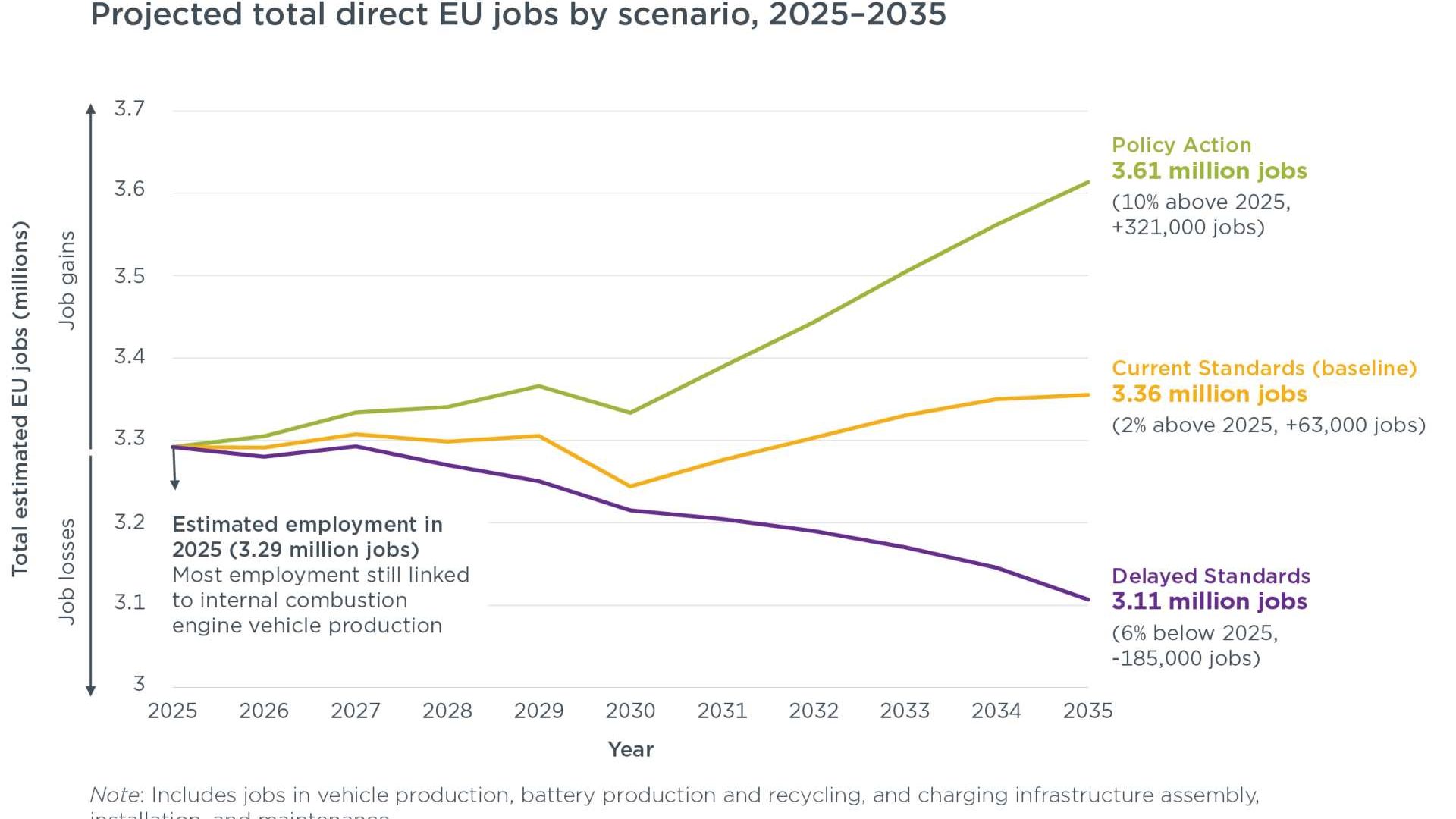
The second scenario combines the existing regulatory framework with additional industrial measures designed to support European manufacturing. These could include production incentives and policies aimed at strengthening domestic supply chains. In this case, employment could increase by approximately 10%, equivalent to around 320,000 additional jobs compared with 2025.
The third scenario assumes a five-year delay in implementing the CO2 standards, resulting in a slower transition to battery electric vehicles. Under these conditions, employment could fall by approximately 6%, representing the loss of up to 185,000 jobs.
The difference between the most ambitious and least ambitious scenarios would therefore amount to approximately half a million jobs by 2035.
The study also suggests that the employment differences between the three scenarios would remain relatively limited until 2030, becoming considerably more pronounced in the following five years.
Not just electrification: European manufacturing is crucial
One of the key findings concerns the geographical distribution of industrial activities. According to the ICCT, the employment impact of the transition will depend not only on how quickly electric vehicles replace conventional models, but also on how much of the associated manufacturing takes place in Europe.

Battery electric vehicle production generally requires fewer workers per vehicle than conventional car manufacturing. However, additional employment in battery production, recycling and charging infrastructure could compensate for this difference, provided that a significant share of these activities remains within the EU.
The researchers therefore argue that maintaining ambitious emission standards should go hand in hand with industrial policies supporting domestic production and investment.
“Weakening the CO2 standards is being presented as a way to protect jobs, but our analysis shows the opposite”, said Sandra Wappelhorst, ICCT Research Lead and the study’s main author.
CO2 standards: why the debate also matters for commercial vehicles
The findings come as European institutions are discussing potential changes to the CO2 emission standards for passenger cars and light commercial vehicles.
Under the currently applicable framework, manufacturers must achieve a 55% reduction in average CO2 emissions from new passenger cars by 2030, compared with 2021 levels, followed by a 100% reduction target from 2035. Vans are covered by the same regulatory framework, although their intermediate targets differ.
In December 2025, the European Commission proposed a revision that would reduce the 2035 target to 90%, while introducing additional compliance mechanisms. The proposal also envisaged lowering the 2030 CO2 reduction target for vans from 50% to 40%.
It is important to underline that the ICCT’s employment projections focus on passenger car production and its associated supply chains. They do not quantify the potential employment impact of regulatory changes on van or heavy-duty truck manufacturing. Moreover, the five-year delay considered in the study is a modelling scenario rather than a direct assessment of the Commission’s specific proposal.
Nevertheless, the findings raise a broader question for the European automotive and commercial vehicle industries: whether relaxing emission targets would genuinely protect established manufacturing activities, or instead risk slowing down investment in the technologies and supply chains on which their future competitiveness may depend.