
EU truck registrations up 7.5% in the first nine months of 2026, while van market remains flat
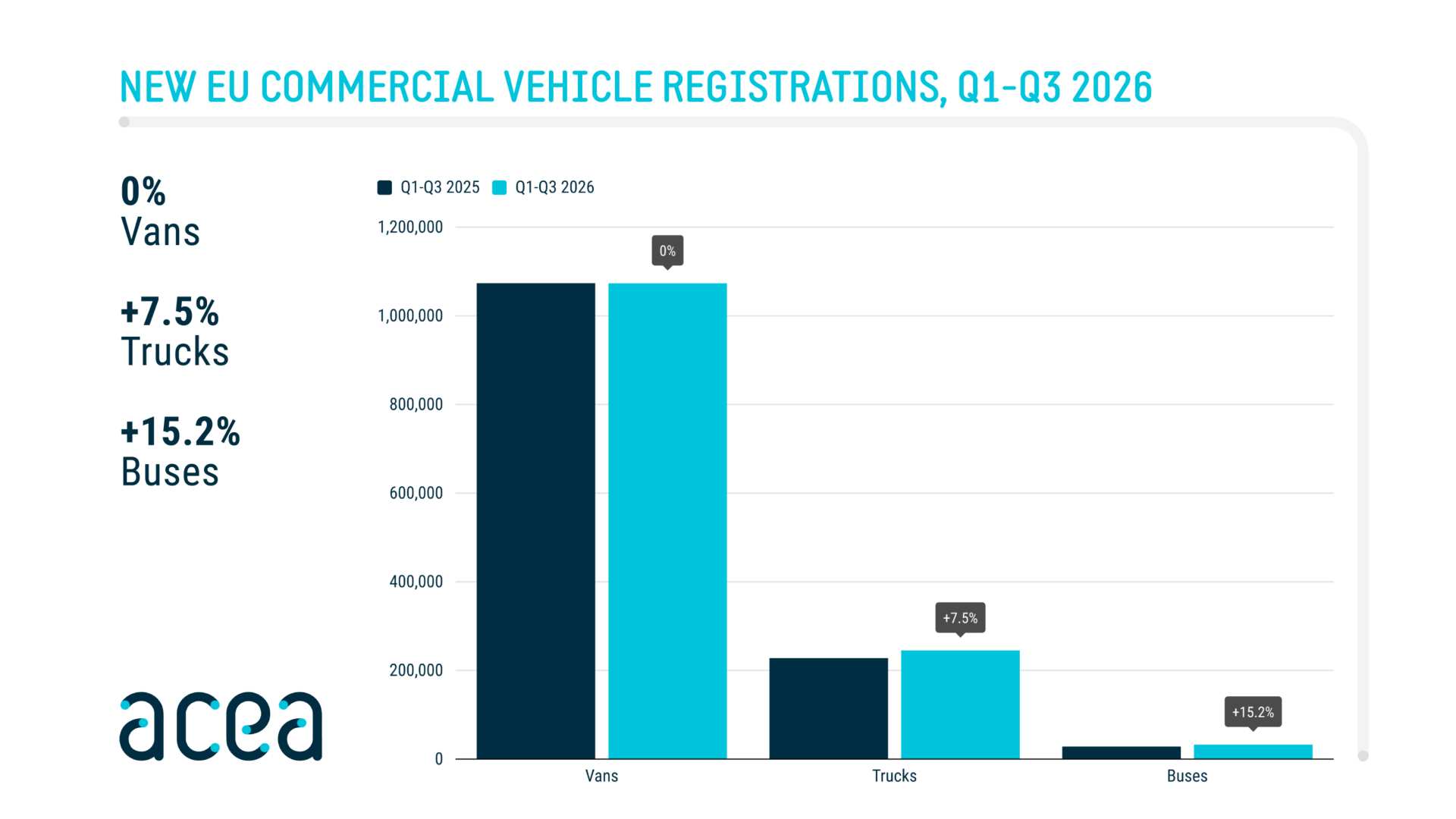
According to the latest ACEA figures, new truck registrations increased by 7.5% in the EU between January and September 2026, while van registrations remained stable. Electrically-chargeable vehicles continued to gain ground in both segments, although diesel still accounts for the vast majority of sales.
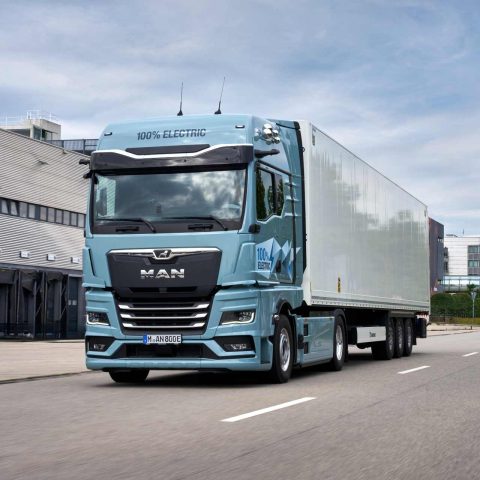
The European Automobile Manufacturers’ Association (ACEA) has released its latest commercial vehicle registration figures, covering the first nine months of 2026. The data reveal contrasting trends in the two main segments of the EU commercial vehicle market: truck registrations increased by 7.5%, reaching 245,079 units, while van registrations remained broadly unchanged at 1,073,427 units.
According to ACEA, the growth in truck sales reflects a recovery from a relatively low comparison base, against a challenging economic backdrop characterised by rising energy prices. Meanwhile, the transition towards electrified powertrains continued, with electrically-chargeable vehicles increasing their market share in both segments.
EU truck market: heavy-duty vehicles drive growth
The positive performance of the European truck market was mainly supported by heavy-duty vehicles, whose registrations increased by 8.5% compared to the same period in 2025. Medium-duty trucks also recorded growth, although at a more moderate rate of 2.5%.
Looking at the major national markets, Poland registered the strongest increase, with truck registrations up 20.5%, followed by Spain (+13.2%). Germany recorded a smaller increase of 2.5%, while France experienced a 1.6% decline.
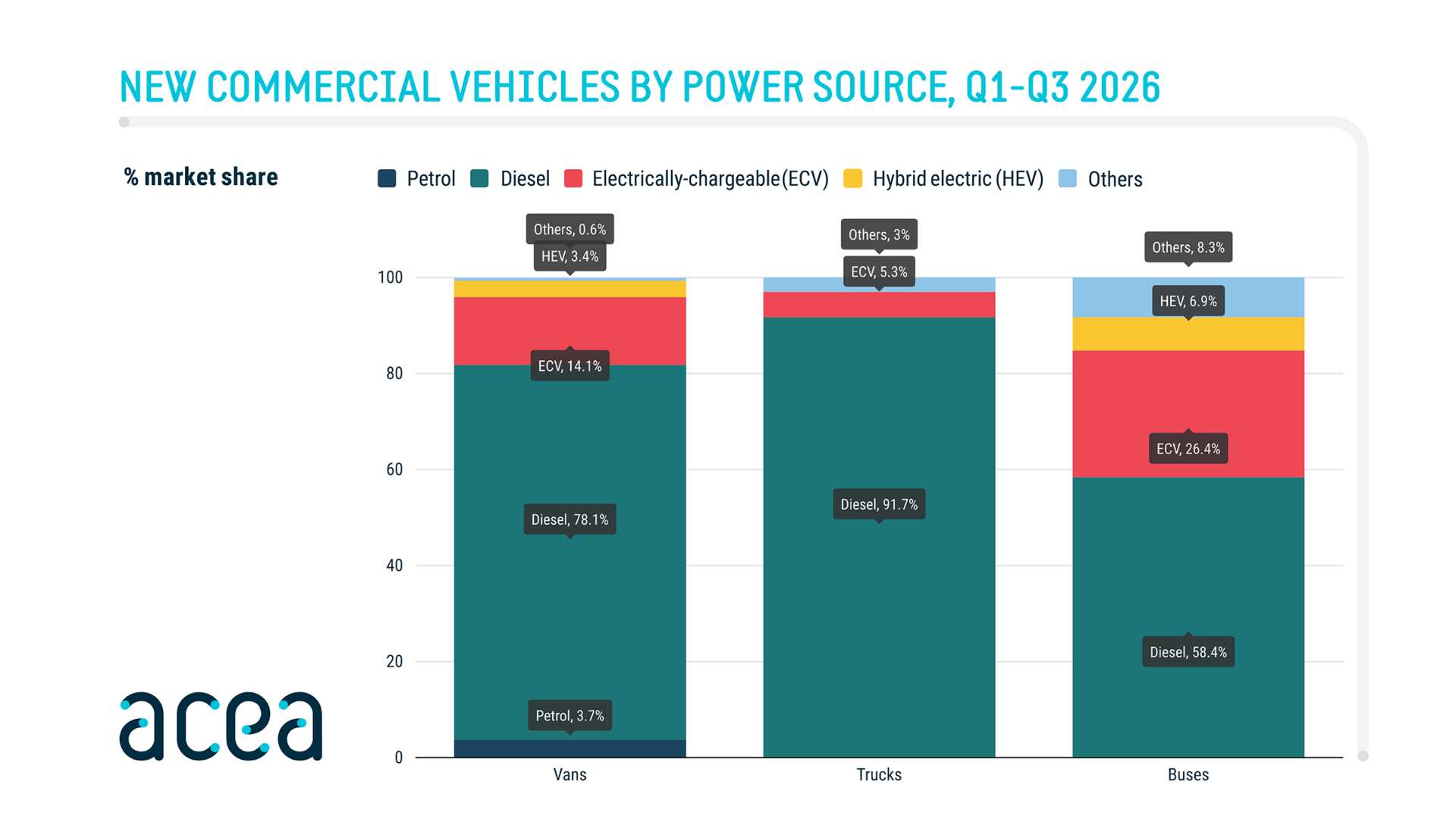
Diesel remains by far the dominant powertrain in the European truck market, accounting for 91.7% of new registrations in the first nine months of 2026. Diesel truck registrations actually increased by 6.6% year-on-year, confirming the technology’s continued importance in commercial transport operations.
At the same time, electrically-chargeable trucks recorded significant growth, with registrations increasing by 49.8% compared to the corresponding period in 2025. Their market share reached 5.3%, reflecting gradual progress in the electrification of road freight transport.
This growth remains highly concentrated in a limited number of countries. Germany (+77.2%), France (+60.2%) and the Netherlands (+57.5%) together accounted for 74% of all electrically-chargeable truck registrations in the EU, highlighting the uneven development of the market across Member States.
Van registrations remain stable, but electric models gain ground
The European van market presented a different picture. Overall registrations remained virtually unchanged in the first three quarters of 2026, with significant differences between the largest national markets.
Spain was the only one of the four major EU markets to record growth, with registrations increasing by 6.9%. Conversely, France experienced a decline of 5.6%, followed by Italy (-5.1%) and Germany (-4.1%).
Despite the overall market stagnation, the shift towards electrified powertrains continued. Electrically-chargeable van registrations increased by 38.2%, reaching a market share of 14.1%, compared to 10.2% in the same period of 2025.
Diesel nevertheless remained the leading choice among van buyers, with 838,830 registrations. However, this represented a 4.3% decline year-on-year, while its market share decreased from 81.7% to 78.1%.
Petrol-powered vans also experienced a significant reduction, with registrations down 19.8% and market share falling to 3.7%. Hybrid vans, on the other hand, recorded growth of 35.6%, although they still accounted for just 3.4% of total registrations.
Electrification continues, but at different speeds
The ACEA figures highlight the different stages of electrification in the European truck and van markets. While electrically-chargeable vans have already reached a double-digit market share, the corresponding figure for trucks remains considerably lower, despite the stronger growth rate recorded in 2026.
The figures also underline the importance of distinguishing between percentage growth and actual market penetration. A nearly 50% increase in electrically-chargeable truck registrations is certainly significant, but these vehicles still represent only slightly more than one in twenty new trucks registered in the European Union.
For both segments, the transition towards electric mobility is progressing, but conventional diesel powertrains continue to dominate new vehicle registrations, particularly in heavy-duty transport.