
Impact launches UNIVERSUS, a modular battery platform for industrial vehicles
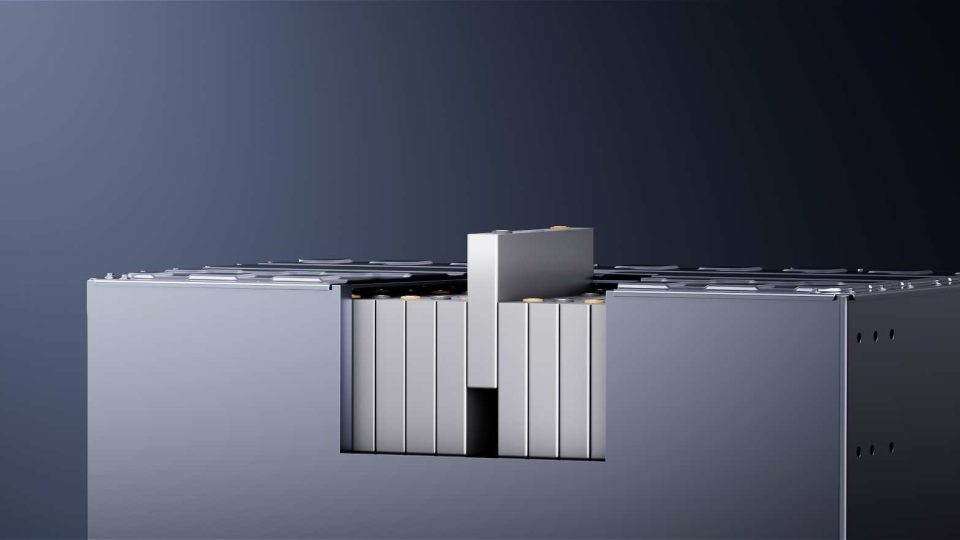
Impact’s new UNIVERSUS traction battery platform gives industrial vehicle manufacturers a common architecture for different applications, voltage classes and battery chemistries. With interchangeable LFP and NMC options, scalable energy capacity and Impact’s in-house BMS, the platform is designed to simplify integration across multiple vehicle types.

Whether they are eTractors, eMunicipal or Airport Ground Support, Refrigeration or Container Handling Vehicles, all industrial machines face the same challenge: small-mid volumes, different vehicle platforms, different chemistries, different voltage classes.
Impact’s new UNIVERSUS traction battery platform is built to end that trade-off across all these business segments. The product is a single, modular and scalable battery platform built on unified architecture, with a mechanical and electrical interface, where mounting and connectors stay identical, while the chemistry, voltage and energy underneath adapt to the application needs.
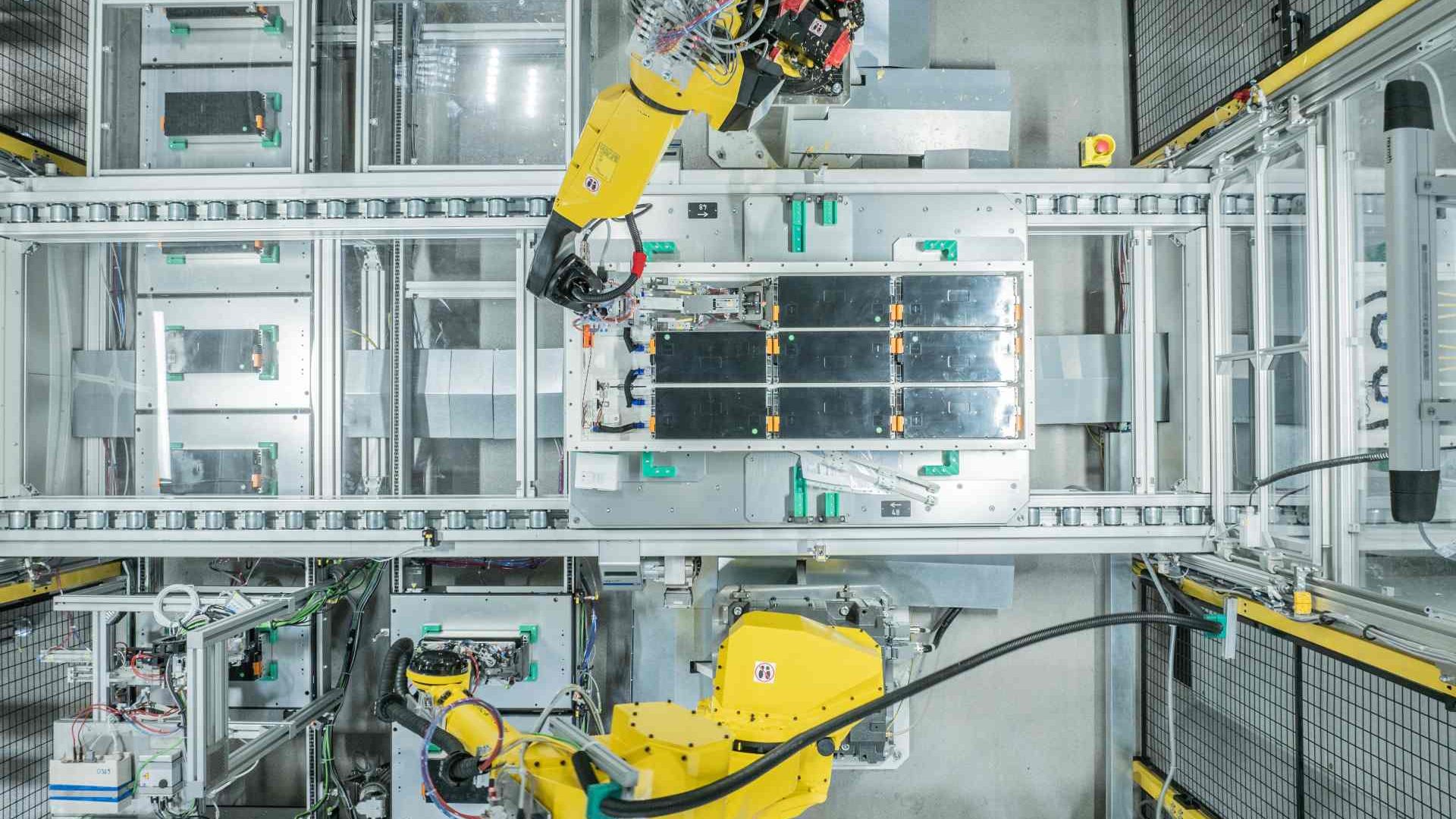
The new Impact UNIVERSUS battery platform
The strength of UNIVERSUS is the flexibility around the specs. By decoupling chemistry and energy from the mechanical and electrical interface, Impact lets a customer commit to one integration and then tune the battery to the job: long-life LFP for a fleet that cycles hard all day, high-energy NMC where every kilowatt-hour counts, and three sizes plus string scaling to hit the exact voltage and capacity target.
Modularity: three layers, countless configurations
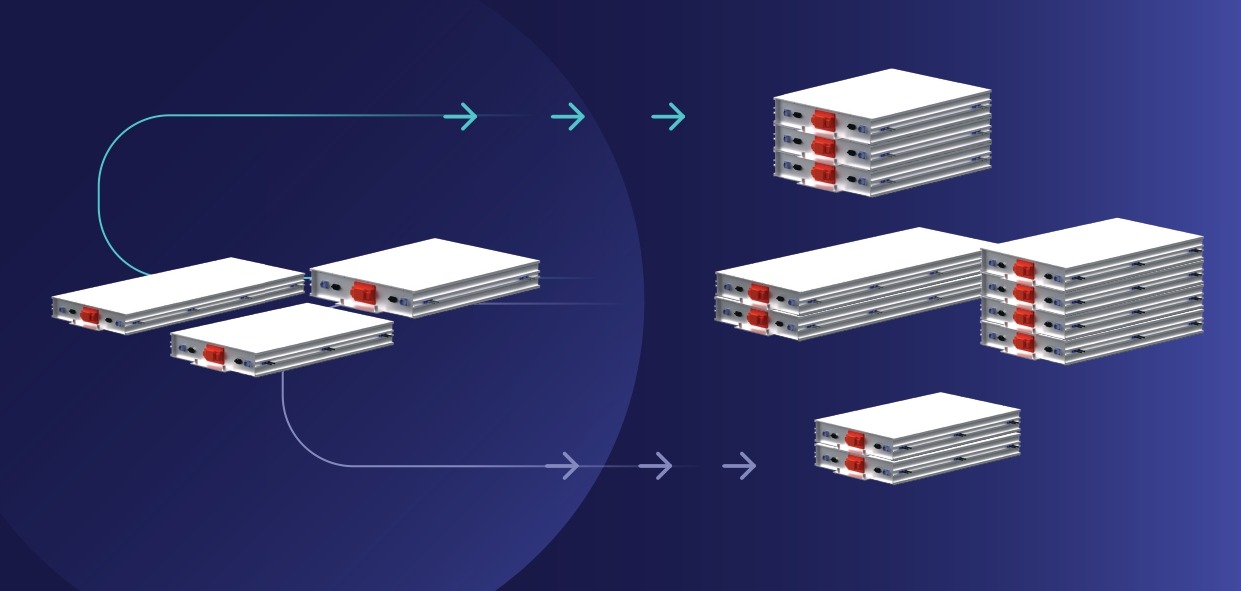
UNIVERSUS is modular on three independent layers – pack size, cell chemistry and voltage/energy scaling – and every layer share one mechanical and electrical interface. Pick one option from each layer and the platform assembles into the exact battery a vehicle needs, from a single small pack running LFP at low voltage 300V up to a multi-string, multi-hundred-kWh 800 V system built from the largest packs.
Two chemistries, one identical footprint
The headline feature is chemistry interchangeability. UNIVERSUS comes in:
- LFP. “Long Life” for maximum cycle life, thermal robustness and cost stability.
- NMC. “High Energy” for higher energy density where range and packaging are tight.
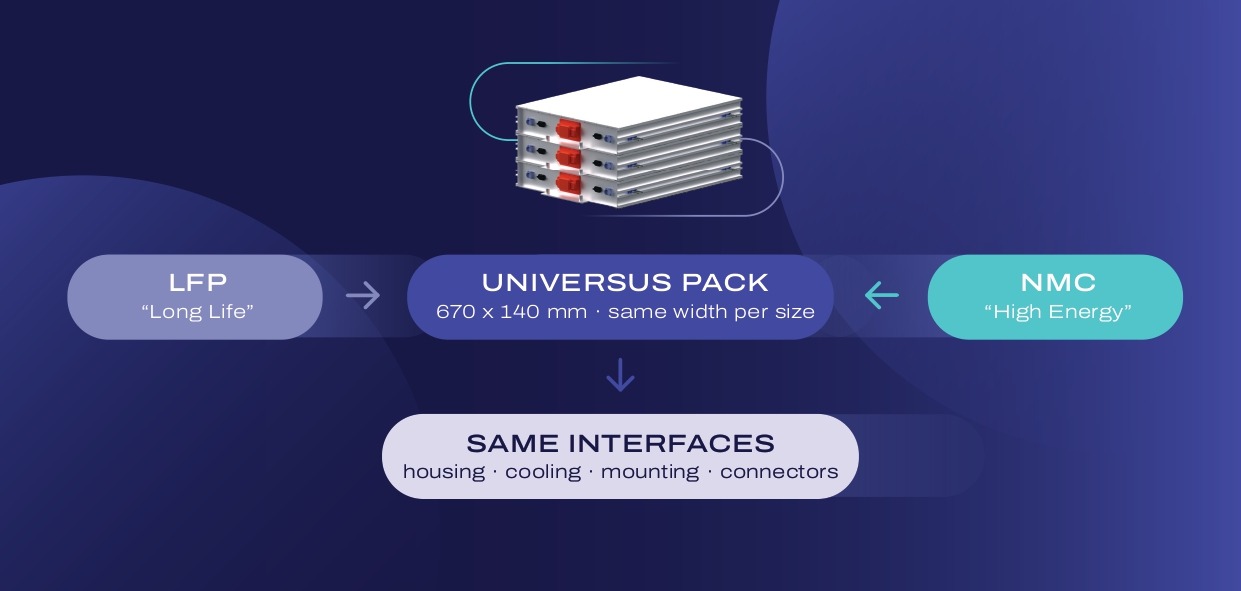
Both chemistries feed the same mechanical/electrical shell. Indeed, the vehicle only ever sees one interface, whichever cell technology is inside.
In addition, as both chemistries share that identical footprint, a vehicle integrated once can switch from LFP to NMC – or run a mixed fleet of both – without redesigning the battery bay, the cooling loop or the harness. Chemistry becomes a specification choice, not a new development project.
Three sizes, one modular building block
Every UNIVERSUS pack keeps a common 670 mm width and 140 mm height, differing only in length. Modules stack and connect in series/parallel to build complete systems, letting integrators reach the two dominant industry voltage classes – 600 V and 800 V – and scale total energy from a few tens of kWh up into the hundreds of kWh (well beyond 800 kWh at full multi-string system level).
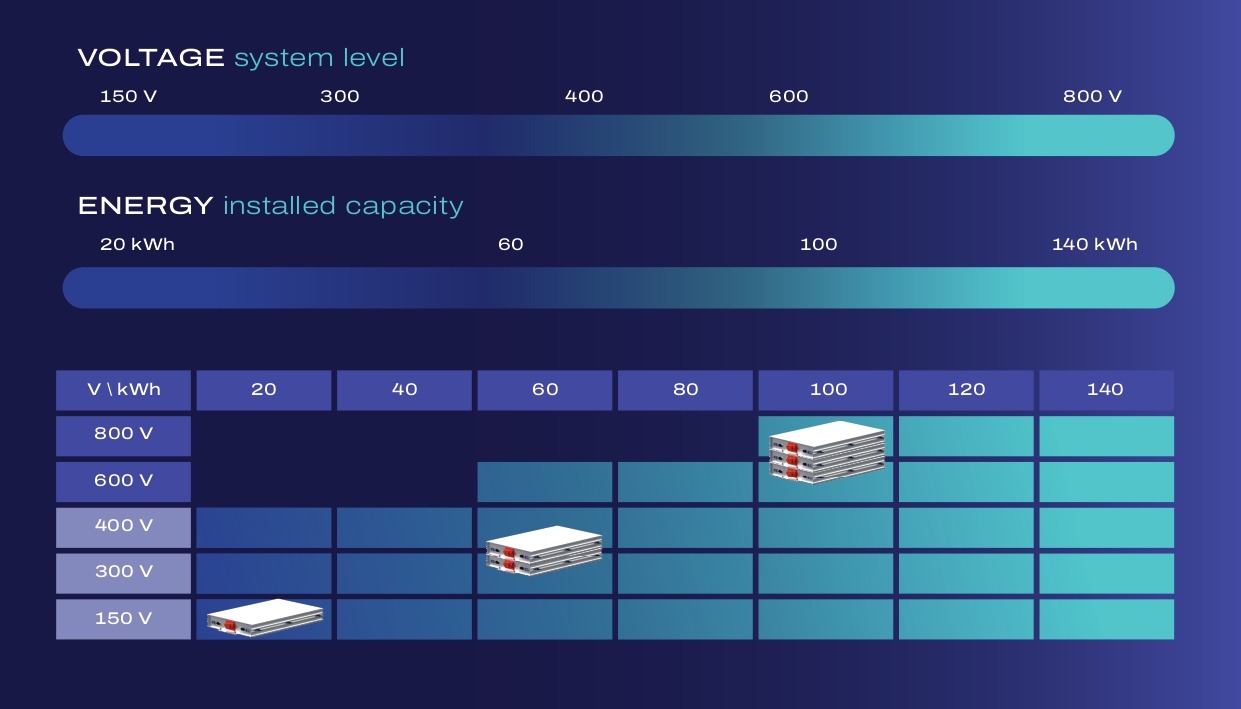
For OEMs and integrators, the battery platform is designed to slot into an existing vehicle architecture rather than force a redesign around itself. Let’s see some of its main features.
- Configurable to user’s architecture. Choose the voltage class, the energy target, and the chemistry – then scale via strings and stacked modules. The platform meets the vehicle’s electrical and packaging envelope instead of dictating it.
- Validated architecture. Every combination is built on the same validated architecture; implementation is fast on both sides. There’s no risk of an unproven design, no troubleshooting from scratch, and no engineering surprises in the field – every variant draws on the same proven, already-deployed architecture.
- Simple, repeatable assembly. A common mechanical interface across all sizes and both chemistries, straightforward screw-mounting, and an accessible MSD for service mean lower integration effort and easier maintenance in the field.
- Fast implementation, for both sides. Every size and chemistry variant is built on the same validated architecture, so integration is engineered once: OEMs reuse it across their range, and Impact manufactures every variant from the same common baseline instead of re-tooling per order – shortening time-to-vehicle for the customer and lead time for the manufacturer alike.
- Functional safety at the core. Impact’s in-house battery management system is developed to the relevant functional-safety frameworks – ISO 26262 (road-vehicle functional safety) and ISO 13849 (safety-related control systems for machinery) – covering both on-road and off-highway/industrial use cases from a single BMS baseline.
- Homologation-ready. Beyond functional safety, the platform is engineered to satisfy the broader set of industry standards and certifications required to bring an electrified vehicle or machine to market (R100.3, ISO 26262, ISO 13849, R10, EN1175, Battery Passport compliance, cybersecurity)
Intelligence built in-house, refined over years
At the heart of every UNIVERSUS pack is Impact’s own Battery Management System 6th gen, developed entirely in-house. A BMS that has matured through successive generations of real-world deployment – across buses, trucks and industrial vehicles already running in more than 30 countries – carries lessons no first-generation software can replicate: how cells actually age under duty cycles, where thermal edge cases hide, what fails in the field rather than in the lab.
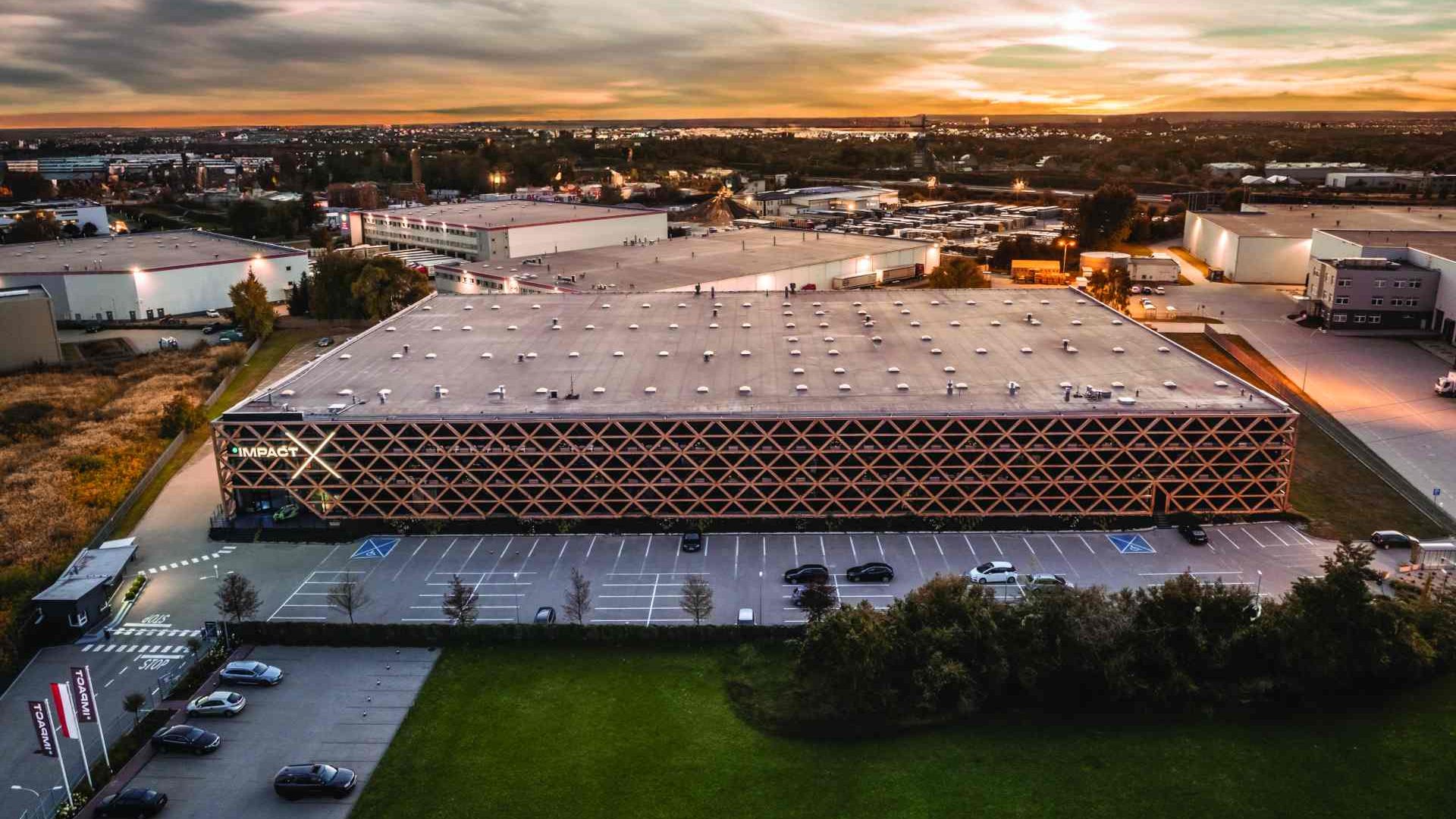
That heritage is built into battery-management algorithms that continuously optimize charge and discharge behavior to extend usable battery lifetime, and into a BMS engineered to meet ISO 26262 (road-vehicle functional safety), ISO 13849 (machinery safety-related control systems) and modern cybersecurity requirements.