

First Renault Trucks electric truck crossing the Channel with Kuehne+Nagel
The truck’s journey started in the companies’ East Midlands Gateway depot, in Derbyshire, UK, with the vehicle completing its journey at a Kuehne+Nagel depot in Amiens, France. The total return journey spanned 1,100 km and marks a milestone in low-emissions logistics. Until now, no heavy-duty electric truck carrying freight had completed this ferry route.
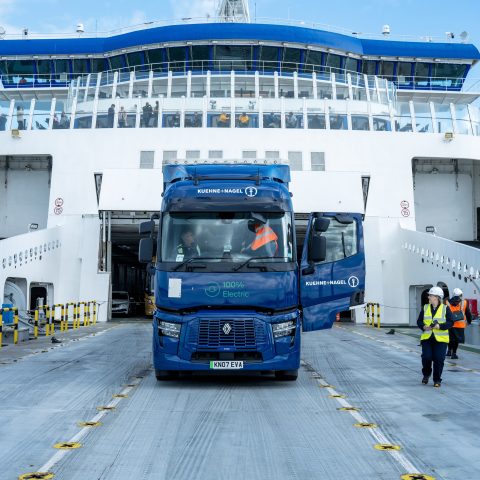
The logistics company Kuehne+Nagel has successfully transported freight from Dover to Calais in a Renault Trucks E-Tech T via ferry. The full electric truck completed the journey aboard a P&O Ferries hybrid vessel, marking a major step forward in the decarbonisation of freight transport.
The first electric truck to cross the Channel via ferry
The truck’s journey started in the companies’ East Midlands Gateway depot, in Derbyshire, UK, with the vehicle completing its journey at a Kuehne+Nagel depot in Amiens, France. After unloading, reloading and recharging, the vehicle then returned to the UK. The total return journey spanned 1,100 km and marks a milestone in low-emissions logistics.
This mission intended to demonstrate the operational viability of electric trucks on international routes and showcases their potential for decarbonising freight transport. The crossing also proves that ferry transport offers a legally feasible and safe route for electric heavy goods vehicles (HGVs) between the UK and mainland Europe. Until now, no heavy-duty electric truck carrying freight had completed this ferry route.