

Electric trucks, Mercedes-Benz eActros LongHaul to be named eActros 600. Series production in 2024
Indeed, the designation '600' is derived from the battery capacity in kilowatt hours – as in the eActros 300/400 for distribution haulage. The high battery capacity and a new, particularly efficient electric drive axle developed in-house enable a range of around 500 kilometers without intermediate charging.
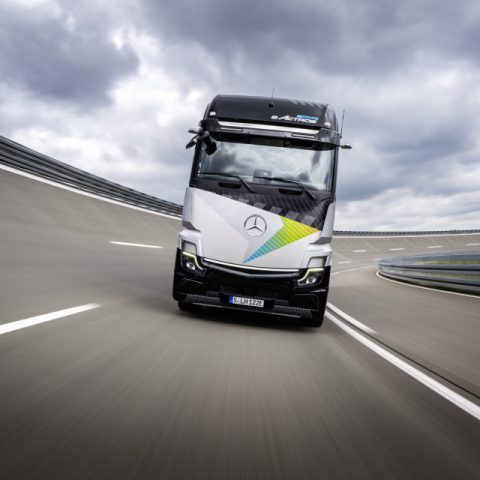
Mercedes-Benz eActros LongHaul electric truck, introduced last year at IAA Transportation exhibition, will be renamed as eActros 600. The world premiere of the electric long-haul vehicle is scheduled in October, while series production is awaited not before 2024, with Mercedes-Benz plants in Wörth, Mannheim, Gaggenau and Kassel getting ready.
Why the name eActros 600
Indeed, the designation ‘600’ is derived from the battery capacity in kilowatt hours – as in the eActros 300/400 for distribution haulage. The high battery capacity and a new, particularly efficient electric drive axle developed in-house enable a range of around 500 kilometers without intermediate charging. Mercedes-Benz Trucks expects that the e-truck will significantly accelerate the far-reaching transformation of road freight transport towards CO2-neutral drives.
Prototypes of the vehicle were put through their paces during winter testing in Finland at the beginning of the year. A fleet of around fifty prototype vehicles is currently being built, which is also planned to go into practical testing with the first customers in the next step.
“The eActros 600, produced in Wörth, is able to replace the majority of diesel trucks in the important long-haul segment, as it sets new standards in terms of cost-effectiveness for our customers. It also offers huge potential for reducing CO2 emissions. I am convinced that this truck will define the new benchmark in road freight transport”, commented Karin Rådström, CEO Mercedes-Benz Trucks.

Electric trucks made in Germany
The eActros 600 will be produced on the existing assembly line at the Wörth production plant, parallel to and flexibly alongside the trucks to be equipped with a diesel drive. The electric drive components will also be installed at that site. The e-axle, high-voltage batteries and the front box, a complex technology module, are mounted in several production steps. Once all high-voltage components have been installed, the entire system is put into operation and the truck is ready to go.
The component plants Mannheim, Kassel and Gaggenau also play an important role in the electrification of the product portfolio. Just like the Wörth plant, all three locations are currently undergoing the process of shifting away from diesel technology to become competence centers for electric drive components. In addition to the tractor unit, Mercedes-Benz Trucks will also produce rigid variants of the eActros 600 right at market launch.