

How to reduce fuel consumption in refrigerated transport without compromising temperature control
In refrigerated transport, reducing fuel consumption requires more than efficient vehicles. Juan Urmeneta of Thermo King explains how route planning, driver behaviour, refrigeration settings, loading practices and equipment choices can help fleets reduce operating costs without compromising temperature control and cargo protection.


Article written by Juan Urmeneta, Product Management Leader, Thermo King Europe, Middle East and Africa
Fuel has always been a volatile cost in road transport. Over the past decade, prices have moved in both directions, but the longer-term trend has remained upward. Sudden spikes, however, continue to present an immediate operational challenge and put pressure on margins.
Operators cannot control fuel markets, but they can control how efficiently their assets are specified, operated and maintained. For refrigerated fleets, however, lower fuel consumption only creates value if it is achieved without compromising temperature performance or load protection.
Understanding the full fuel picture
When assessing fuel spend, fleet managers often look first at the tractor or truck, and with good reason: it usually represents the largest share of fuel consumption. But in temperature-controlled transport, that is only part of the picture. Where a transport refrigeration unit is in use, fuel efficiency should be considered across the full asset lifecycle, not simply on a week-to-week basis. While the refrigeration unit may consume much less fuel in the short term, its cumulative fuel use can still be substantial over time.
Potrebbe interessarti

Thermo King, electrification and efficiency in refrigerated transport: our interview with Claudio Zanframundo
Fuel use by the transport refrigeration unit adds up significantly because these systems often run for long hours over extended service lives. For example, if a fleet operates 20 trailer refrigeration units, each running 2,000 hours per year over a seven-year lifespan, fuel consumption can reach 35,000 litres per unit over its lifetime. Even modest efficiency gains can become commercially significant when multiplied across assets, operating hours and years of service.
How can fleets avoid wasting fuel?
There is no single fix for improving fuel efficiency in refrigerated transport. In most cases, meaningful reductions come from a combination of disciplined operation and the right technology choices. Five areas consistently stand out.
- Optimise routes, not just distance
It is easy to assume that the shortest route will also be the most fuel-efficient. In practice, that is not always the case. Congestion, elevation, stop-start traffic, idling and waiting time at delivery points and the duration of door openings can all affect fuel use for both the vehicle and the refrigeration unit.
A more effective approach is to analyse route performance in operational terms, not simply in miles or kilometres. Which routes generate prolonged idling? Which involve repeated urban stops? Which create greater thermal stress because of ambient conditions, traffic delays or delivery patterns? Which require the unit to work harder to recover temperature after frequent door openings?

Using route and operating data to answer those questions helps fleets identify where fuel is being consumed disproportionately and redesign schedules or delivery patterns accordingly.
- 2. Train drivers in fuel-efficient driving
Fuel performance is influenced by more than engines alone. Driver behaviour has a direct impact on fuel and power consumption. Smooth acceleration, reduced idling, better anticipation in traffic and more consistent driving habits all contribute to improved efficiency.
Eco-driving programmes are often discussed in general freight, but they are just as relevant in temperature-controlled operations. The most effective programmes are evidence-based, using telematics and route data to pinpoint where driving patterns are contributing to excess fuel use and target coaching where it will have the greatest impact.
- 3. Reduce unnecessary refrigeration unit run-time
One of the most avoidable sources of fuel waste is unnecessary refrigeration unit operation. Any period in which the unit is working harder than required, or running when it adds little value, increases fuel consumption without improving outcome.

Common causes include:
- Frequent door openings. Each door opening allows cold air to escape and warmer ambient air to enter. The result is predictable: the unit must work harder to pull temperature back down once the doors are closed. Operational discipline helps, but physical interventions matter too. Simple solutions, like an energy curtain, can eliminate this problem almost completely and minimise the work done by the cooling unit. Upgrading the vehicle with electronic door switches will also automatically turn off the unit when the doors are open, reducing avoidable losses.
- Operating mode not matched to the load. Not every cargo requires the same control strategy. Some loads demand tight temperature management and continuous operation. Others can be transported effectively using cycle sentry, less fuel-intensive settings. Selecting the right operating mode for the thermal sensitivity of the goods is one of the simplest ways to improve efficiency without compromising load protection. On Thermo King Advancer trailer units, the ECOmode limits temperature deviations from the set point and ensures sequential airflow for optimal cargo-protection. This reduces fuel consumption by up to 50% compared to continuous operation but offers significantly tighter temperature control than cycle-sentry.
- Excessive pull-down demand. Refrigeration systems are designed primarily to maintain product temperature, not to remove large quantities of field heat from improperly prepared loads. If cargo enters the vehicle too warm, the system must work harder and longer, consuming more power in the process.
This is an area where operational discipline and technology configuration need to work together. The objective is not to run the unit less at any cost; it is to run it only as much as necessary for the load and conditions.
- 4. Optimise loading practices
Fuel efficiency is influenced not only by route and equipment, but also by how the load is prepared and positioned inside the body or trailer. Poor loading can obstruct airflow, create uneven temperature zones and force the refrigeration system to work harder than necessary.
Several principles are particularly important:
- Ensure there is adequate airspace around and between the goods.
- Avoid blocking airflow paths, especially near the evaporator and return air channels.
- Pre-cool products before loading wherever operationally possible.
- Do not stack pallets or cases so high that they interfere with air distribution.
- Keep the floor free of debris so that air can circulate properly through the load space.
These are basic disciplines, but they are often overlooked under time pressure.
- 5. Treat equipment selection as a long-term efficiency decision
Many fuel-saving measures are operational or behavioral. However, there are situations where the equipment itself may no longer be the best fit for the application, or where older technology is adding unnecessary cost over time.
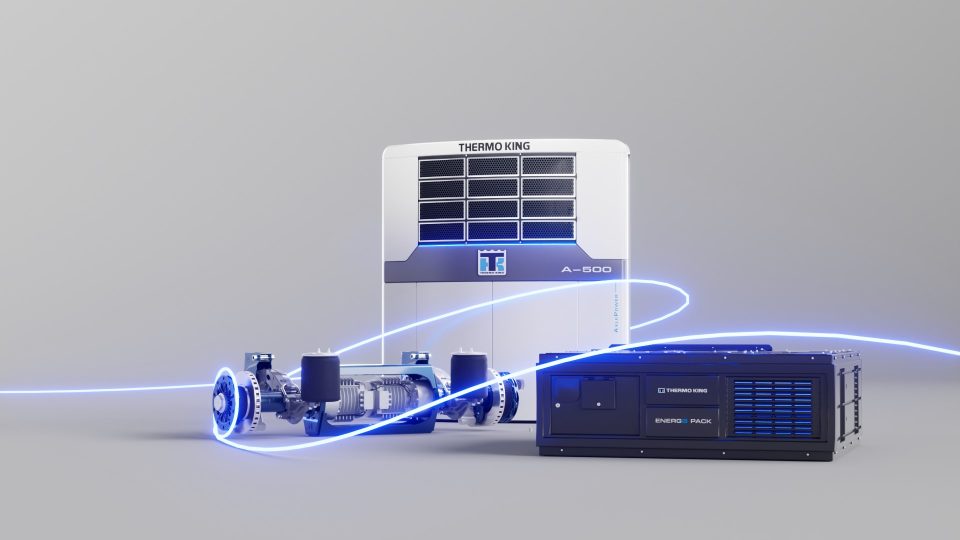
This is particularly relevant today, as technology innovation empowers operators with a broader mix of power options than in the past. Diesel remains important in many applications, but hybrid systems, battery-supported architectures, AxlePower energy recovery technologies and fully electric solutions are now practical options in all use cases – reducing or even removing the need for diesel to power refrigeration units.

Full electrification is the clearest route to removing diesel consumption from the refrigeration system itself, and it is particularly relevant where urban operation, noise constraints and sustainability objectives are influencing decisions. But for most operators, the transition will not be a single leap from conventional diesel to fully electric. It is more likely to be phased, with different technologies applied across different duty cycles and operating environments.
What matters is not adopting technology for its own sake but selecting the configuration that delivers the strongest operational and economic fit. That is why specification decisions should be grounded in duty-cycle analysis rather than headline claims alone.
The cost of poor temperature control
The practical measures outlined above can make a meaningful difference to fuel use, but fuel efficiency should not be considered in isolation from temperature control. Marginal fuel savings can quickly be erased if inconsistent temperature performance leads to spoilage, waste, reduced product quality, rejected loads, compliance risk or avoidable claims.
Potrebbe interessarti
Here’s how Thermo King aims to decarbonise the food cold chain
In refrigerated transport, the objective is not simply to minimize fuel consumption, but to do so while maintaining the stable, appropriate temperature the cargo requires. A refrigeration system may appear efficient on paper if it consumes less fuel under certain conditions, but that is a poor trade-off if it achieves those savings by allowing wider temperature variation or weaker load protection.
Whatever approach fleets take to reefer fuel efficiency, the priority should remain the same: ensuring every load arrives in the right condition, with the right level of temperature control, every time. That is the standard by which efficiency should ultimately be judged.