
Amazon and Tata Motors plan to deploy 3,000 electric trucks across India
Amazon and Tata Motors have announced a collaboration to introduce 3,000 electric trucks into the e-commerce company's Indian logistics network. Starting with the Tata Ultra E.7 in Delhi, the initiative aims to expand electric freight transportation to major highway corridors.
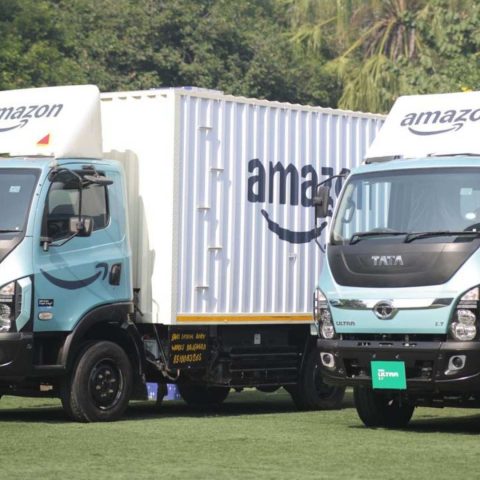
Amazon is taking another step towards the electrification of its logistics operations in India. The e-commerce giant has announced a collaboration with Tata Motors to deploy 3,000 electric trucks, extending the use of zero-exhaust-emission vehicles beyond last-mile deliveries to freight transportation between logistics facilities, within cities and eventually along major national highways.
Announced on October 27, the initiative represents what the two companies describe as the largest electric truck deployment planned by an e-commerce company in India. The first batch of vehicles was officially flagged off in New Delhi, in the presence of India’s Minister for Heavy Industries and Steel, H. D. Kumaraswamy.
Under the agreement, Tata Motors will supply the electric trucks, while Amazon’s transport partners will own and operate the vehicles. The collaboration therefore brings together the manufacturer’s vehicle technology and service capabilities with Amazon’s logistics network and freight demand.
The first phase: Tata Ultra E.7 electric trucks in Delhi
The initial deployment focuses on light- and medium-duty electric trucks operating within Amazon’s middle-mile transportation network, connecting fulfilment centres and other logistics facilities. The first batch comprises 20 Tata Ultra E.7 electric trucks, introduced in Delhi during the festive season, when e-commerce freight volumes typically increase.
Designed for urban and regional distribution, the Tata Ultra E.7 features a 96 kWh lithium iron phosphate (LFP) battery, a 240 kW electric motor and an integrated e-axle. According to Tata Motors’ technical specifications, the vehicle offers a maximum range of up to 130 km and a payload capacity of approximately 3.1 tonnes, depending on configuration.
The truck also supports CCS2 fast charging and regenerative braking, while its equipment includes a crash-tested cabin and high-voltage safety systems.
Beyond the initial vehicle deployment, Tata Motors will provide charging infrastructure support, servicing and operational assistance, with the aim of facilitating the integration of electric trucks into existing logistics activities.
A 2,800-km electric freight corridor between Delhi and Chennai
The second phase of the initiative is considerably more ambitious. Amazon and Tata Motors intend to expand electric truck operations to major national highways, starting with the 2,800-km Delhi–Bengaluru–Chennai corridor along National Highway 48.
The route crosses seven Indian states and connects six of the country’s largest e-commerce regions. Electrifying freight operations along this corridor will require a different approach from urban distribution, particularly in terms of vehicle range, charging infrastructure and operational planning.
To support this expansion, the companies are working on the development of dedicated charging infrastructure, including hubs established in cooperation with charging provider Yahhvi. The company has already supported the development of ten charging yards across India as part of Amazon’s existing fleet electrification activities.
The initiative also comes amid efforts by Indian authorities to accelerate electric commercial vehicle adoption. In particular, Delhi’s 2026 EV Policy provides incentives for early adopters, including exemptions from daytime entry restrictions for qualifying medium-duty electric trucks.
Amazon expands electrification beyond last-mile delivery
Amazon already has more than 15,000 electric vehicles operating across over 500 Indian cities, largely supporting its urban distribution activities.
The collaboration with Tata Motors is intended to extend electrification to heavier freight applications, where operating conditions, daily mileage and charging requirements present additional challenges.
According to Rajesh Kaul, Vice President and Business Head – Trucks at Tata Motors, electric trucking in India is moving beyond the pilot stage towards broader commercial adoption. The company believes that local manufacturing, vehicle efficiency and integrated support services could make battery-electric trucks increasingly competitive for transport operators.
For Amazon, the project forms part of its wider commitment to achieving net-zero carbon emissions by 2040.
While the planned deployment of 3,000 vehicles would represent a significant expansion of electric freight transportation in India, the companies have not disclosed the financial value of the agreement or a detailed delivery schedule.