

Electric truck charging demand could reach 100 TWh in Europe by 2035, ICCT study finds
Electric trucks could require around 100 TWh of charging energy annually across Europe by 2035 under a moderate electrification scenario, according to a new ICCT and Fraunhofer ISI study. Most demand would come from depot charging and be heavily concentrated around major freight corridors and logistics hubs.
The electrification of Europe’s truck fleet could create annual charging demand of around 100 TWh by 2035, rising to approximately 200 TWh by 2045, according to a new study by the International Council on Clean Transportation (ICCT) and Fraunhofer ISI.
Perhaps more important than the overall figures, however, is where that demand is expected to materialise. The researchers find that electric truck charging will be highly concentrated around a relatively small number of freight corridors, logistics hubs and industrial areas, potentially creating substantial local requirements for charging infrastructure and grid capacity.
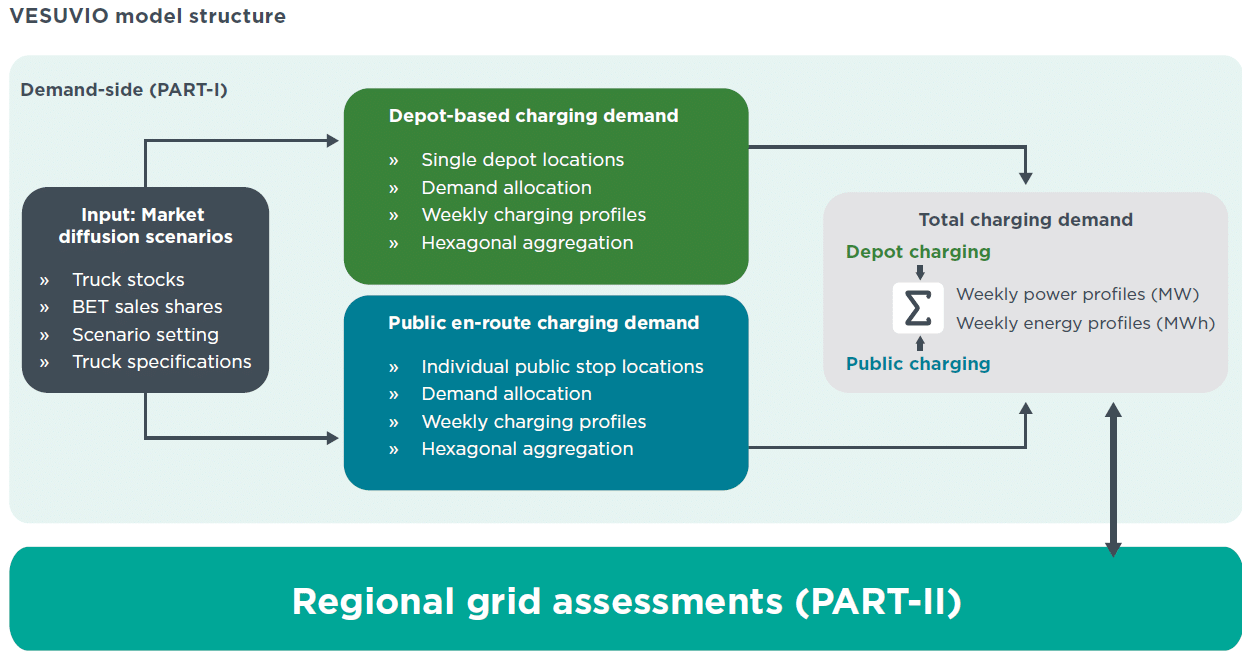
The study, Spatiotemporal analysis of electric truck charging demand in Europe, covers the EU-27 plus Norway, Switzerland and the United Kingdom. It uses the newly developed VESUVIO model to estimate depot and public en-route charging demand geographically and over time. Demand is mapped using cells of around 250 km², with charging profiles modelled at 15-minute intervals.
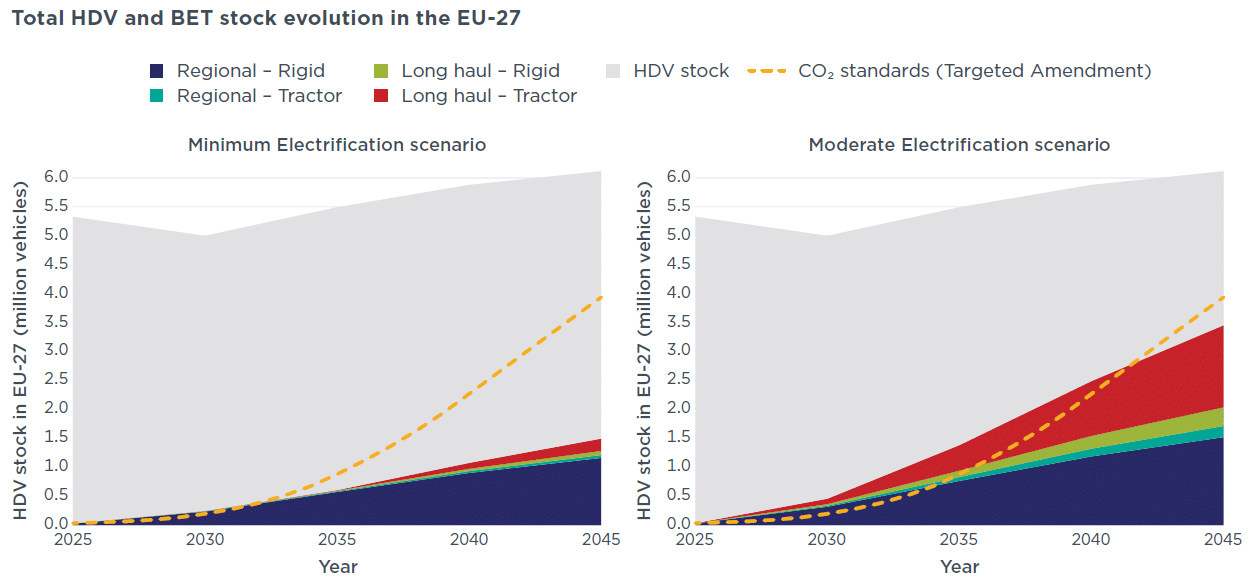
The 100 TWh figure for 2035 refers to what the researchers call their Moderate Electrification scenario. Under the more conservative Minimum Electrification scenario, demand would instead reach around 30 TWh in 2035. By 2045, the two scenarios produce approximately 200 TWh and 75 TWh respectively.
Germany, France, the United Kingdom, Spain and Italy are among the countries expected to generate the largest overall demand.
Depot charging remains the backbone
One of the clearest findings is the importance of private charging infrastructure. According to the study, depot charging typically accounts for more than 70–80% of total truck charging energy, with return-to-depot regional operations forming the backbone of demand in most countries.
Public charging nevertheless remains essential, particularly for long-haul operations. Its importance also varies considerably between markets: in some smaller transit countries, public en-route charging can represent 30–50% of total truck charging demand.
This variation leads the researchers to caution against a uniform approach to charging infrastructure across Europe. Fleet composition, freight activity and geography differ substantially between countries, producing different combinations of depot and public charging requirements.
That distinction also has implications for policy. While regulations such as AFIR establish requirements for public heavy-duty charging along the TEN-T network, ICCT and Fraunhofer argue that support for depot infrastructure and its grid connections will be equally important given the amount of energy expected to be delivered there. Embargoed report, ICCT-Fraunhof…
A small number of locations could account for most charging demand
The geographical concentration identified by the model is particularly striking. Across many countries, the top 1% of areas account for roughly 25–33% of truck charging energy, with the proportion approaching 50% in some cases.
Expand that to the top 10% of locations and the model captures between 60% and 90% of total national charging demand. These hotspots tend to coincide with major motorway corridors, industrial centres and logistics clusters.
For infrastructure planners, this suggests that the challenge may be less about providing equally dense capacity everywhere than identifying the places where very large loads will develop.
The same pattern emerges when looking at power rather than energy. In larger freight markets, the most heavily loaded areas frequently reach local peak charging demand of 20–50 MW. In a few exceptional cases, including the UK and Luxembourg under the Moderate Electrification scenario in 2045, the model produces peaks exceeding 50 MW.
The authors therefore argue that grid constraints are likely to emerge first at specific charging hotspots rather than uniformly across national electricity systems. Large depots and locations along heavily used motorway corridors could consequently require substantial grid reinforcement.
Peak demand could be higher than the model suggests
There is an important caveat to those numbers. VESUVIO models charging patterns using a representative average week, rather than the busiest periods of the year.
Additional analysis carried out by the researchers indicates that during particularly busy periods — expected around two or three times a year — truck traffic and associated electricity demand could be approximately 30–40% higher than the average. The report therefore acknowledges that its results may underestimate extreme local peak loads, even if the geographical location of the main hotspots is unlikely to change.
There are other limitations. The study currently covers only heavy trucks above 12 tonnes, while much of the empirical information used to construct charging profiles comes from Germany and Central Europe. The authors also note that alternative strategies — including smart charging, different combinations of slow and fast charging, on-site solar generation, stationary storage and vehicle-to-grid applications — could produce different load profiles.
The current report is also only the demand-side part of the VESUVIO project. A subsequent ICCT-Fraunhofer study will compare the projected charging demand at this granular geographical level with the actual capacity of local electricity grids, with the aim of identifying potential mismatches and priority areas for investment.
For the authors, the results support a more proactive approach to grid planning: rather than waiting for individual connection requests before expanding capacity, infrastructure and grid operators could use projected freight demand to identify areas where large-scale truck charging is likely to emerge and prepare those locations in advance.