

Kia PV7 goes bigger with up to 8 cubic meters of cargo space and 460 km range
Kia has revealed the PV7, the second model in its dedicated electric PBV family. Larger than the PV5, the new van offers up to 8 cubic metres of cargo capacity, a preliminary WLTP range of more than 460 km and an 800-volt architecture for faster charging.
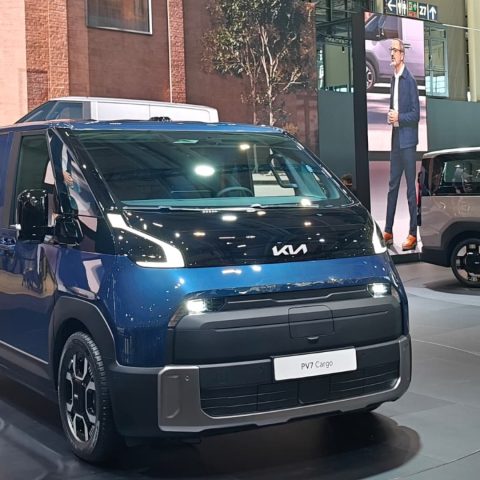
Kia is taking the next step in its electric commercial vehicle strategy with the PV7, the larger sibling of the PV5 and the second model developed around the Korean manufacturer’s dedicated Platform Beyond Vehicle (PBV) architecture.
Presented at IAA Transportation 2026 in Hannover, the PV7 moves Kia into a larger van segment, combining increased cargo capacity with longer range and significantly faster charging. It will initially be offered in Cargo and Passenger versions, with European sales scheduled to begin in the second half of 2027.
At 5.35 metres long and 1.995 metres wide, the PV7 is substantially larger than the PV5. The Cargo Long provides 6.1 cubic metres of load volume, while a High Roof version will increase capacity to as much as 8 cubic metres. Maximum payload reaches around 1.2 tonnes, while the cargo area can accommodate up to three Euro pallets.
More than 460 km of range for the Kia PV7
Like the PV5, the new van is based on Kia’s dedicated E-GMP.S architecture, although the PV7 introduces an 800-volt electrical system.
Two battery options will be available, with capacities of 71.5 and 96.2 kWh. The larger battery gives the PV7 Cargo Long a preliminary WLTP range of more than 460 km.
The electric motor develops up to 200 kW and 420 Nm, with front-wheel drive offered initially and an all-wheel-drive version planned for a later stage. Preliminary towing capacity is up to two tonnes.
The 800-volt architecture also brings a significant improvement in charging performance compared with the PV5. Connected to a 350 kW DC charger, Kia says the PV7 can replenish its battery from 10 to 80% in approximately 20–25 minutes.
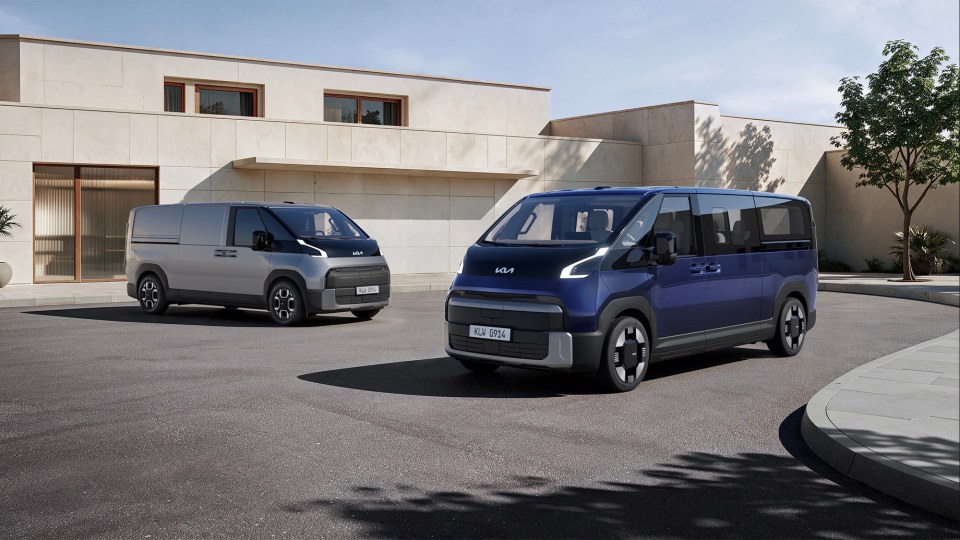
Cargo and Passenger, with more versions to come
The PV7 has been conceived from the outset for both goods and passenger transport. In addition to the Cargo derivatives, the Passenger version will be offered in Europe with configurations for up to nine occupants, targeting applications including shuttle and professional passenger transport.
And the range will eventually become considerably broader. Kia plans 23 PV7 variants and conversion models, including Compact, Long and High Roof Cargo versions, Passenger derivatives and a Chassis Cab for specialist conversions.
The PV7 therefore extends the strategy Kia started with the PV5 rather than replacing it: the smaller model remains focused primarily on urban and lighter-duty applications, while the additional space, battery capacity and 800-volt architecture of the PV7 open the PBV platform to more demanding commercial operations.
Production will take place at Kia’s dedicated PBV facility in Hwaseong, South Korea, with the Cargo and Passenger versions due to reach Korea and Europe in the second half of 2027.