

Fuel cell trucks, Mercedes-Benz tests the GenH2 in the Swiss Alps
During testing, the interaction of all essential components was tested intensively, including the fuel cell, the high-voltage battery, the e-axle, the tank system, and thermal management. A particular focus was on the use of the Predictive Powertrain Controls system. Also, the vehicles were refueled via a mobile hydrogen refueling station from Air Products, which was set up at the test base in Valais.
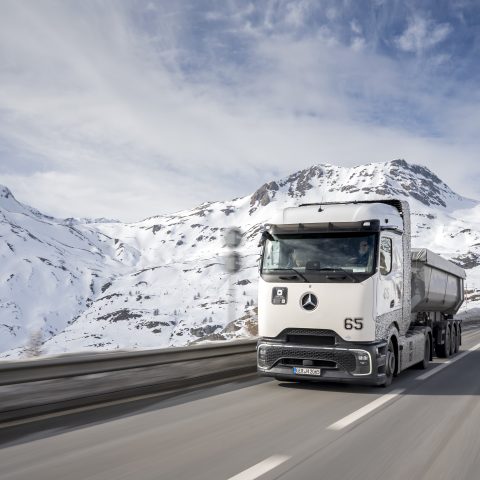
Daimler Truck’s development team has built up first prototypes of Mercedes-Benz’ next generation fuel cell trucks and has recently put them through their paces in a first series of demanding tests. More into details, the GenH2 fuel cell trucks underwent intensive winter testing at the Simplon Pass in the Swiss Canton of Valais.
Mercedes-Benz GenH2: some more details about the tests
During testing, the interaction of all essential components was tested intensively, including the fuel cell, the high-voltage battery, the e-axle, the tank system, and thermal management. A particular focus was on the use of the Predictive Powertrain Controls system, the topography-dependent cruise control. The objective was to use the battery in combination with the fuel cell efficiently. The vehicles covered a total of 6,500 kilometers and crossed mountain roads with an accumulated climb of 83,000 meters. Particularly challenging were the approx. 20-km-long up- and downhill stretches with gradients of 10 to 12 percent, with a total distance covering 1,600 kilometers.
According to Daimler Truck, the vehicles were refueled via a mobile hydrogen refueling station from Air Products, which was set up at the test base in Valais. “For the further development of our Mercedes-Benz GenH2 Truck, we are seamlessly building on the experiences of the first prototype generation and are therefore able to test the improved technology under extreme conditions right from the outset,” explained Rainer Müller-Finkeldei, Head of Mercedes-Benz Trucks Product Engineering. “With a maximum elevation of more than 2,000 meters above sea level and a climb from 600 meters, the route over the Simplon Pass provided good conditions for testing the interplay of the fuel cell system with other enhanced components. The successful tests have underlined the potential and reliability of the GenH2 Trucks, even under demanding conditions.”