
Logistics provider Dachser grows by 3% year-on-year, mainly due to M&A policy
In the previous year, Dachser’s focus was on the rapid integration of its recent acquisitions, particularly in Italy (DACHSER & FERCAM Italia), southern Germany and Austria (Brummer), and the Nordic countries (Frigoscandia). All three contributed fully to Group revenue for the first time in 2025. Excluding these acquisitions, Dachser would have grown by just 0.3 percent compared to the previous year.
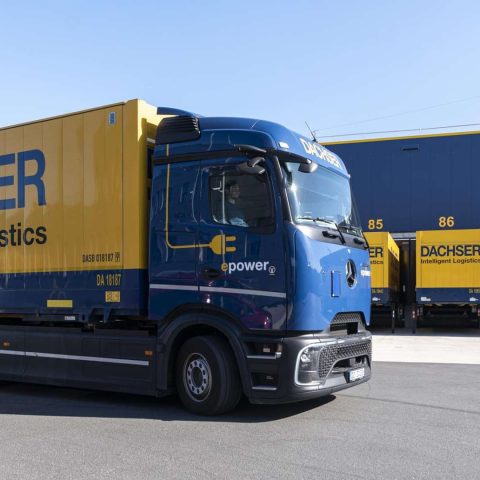
Photo credit: Helmut Bauer
Logistics provider Dachser increased its revenue to around EUR 8.3 billion in the 2025 financial year. This is 3.1 percent higher than the previous year and sets a new record for the company. Moreover, the tonnage transported rose to 46.7 million metric tons (+5.8%), while the number of shipments increased to 86.2 million (+3.6%).
In the previous year, Dachser’s focus was on the rapid integration of its recent acquisitions, particularly in Italy (DACHSER & FERCAM Italia), southern Germany and Austria (Brummer), and the Nordic countries (Frigoscandia). All three contributed fully to Group revenue for the first time in 2025. Excluding these acquisitions, Dachser would have grown by just 0.3 percent compared to the previous year.
Dachser financial year in details
More into details, Dachser’s Road Logistics business field—which comprises the transport and warehousing of industrial and consumer goods (European Logistics) and food (Food Logistics)—increased its revenue by around 7 percent last year to EUR 6.9 billion. Revenue in the European Logistics business line broke EUR 5 billion for the first time to reach EUR 5.1 billion. Dachser grew here by 5.9 percent compared to the previous year.
In the Air & Sea Logistics business, revenue fell by 12.6 percent to some EUR 1.4 billion, after having grown by 22 percent from 2023 to 2024. Finally, in Contract Logistics, which combines transport, warehousing, and customer-specific value-added services, Dachser has grown strongly in recent years. In 2025, the logistics provider added space for roughly another 240,000 pallets at its 174 warehouse locations worldwide.
“In 2025, the economic environment we had to operate in remained difficult. While European core markets stagnated and grappled with high cost and competitive pressure, US tariff policy created additional uncertainty in global trade,” said Burkhard Eling, Dachser CEO. “The fact that we were able to grow organically under these conditions and even gain market share in overland transport proves the strength and resilience of our business model, which is based on integration, quality, and innovation.”