
Global EV battery market grows 20%. Chinese manufacturers now hold over 72%
Global EV battery usage reached 608.5 GWh in the first half of 2026, according to SNE Research, up 20% year-on-year. CATL strengthened its leadership with almost 40% of the market, while seven Chinese manufacturers together accounted for 72.4% of global battery deployment.
The global battery market continues to expand, but growth is becoming increasingly concentrated among Chinese manufacturers. According to the latest figures released by SNE Research, battery usage for electric vehicles reached 608.5 GWh between January and June 2026, an increase of 20% compared with the same period last year. The analysis covers batteries installed in EVs, plug-in hybrids and hybrids registered across 80 countries.
More significant than the overall growth rate, however, is the increasing concentration of the market. Seven Chinese companies among the world’s ten largest battery manufacturers now account for 72.4% of global deployment, 1.5 percentage points more than a year earlier.
CATL approaches a 40% global market share
CATL remains by far the world’s largest battery manufacturer. The Chinese group supplied 242.7 GWh during the first six months of the year, 25.3% more than in the first half of 2025. Its global market share consequently increased from 38.2% to 39.9%.
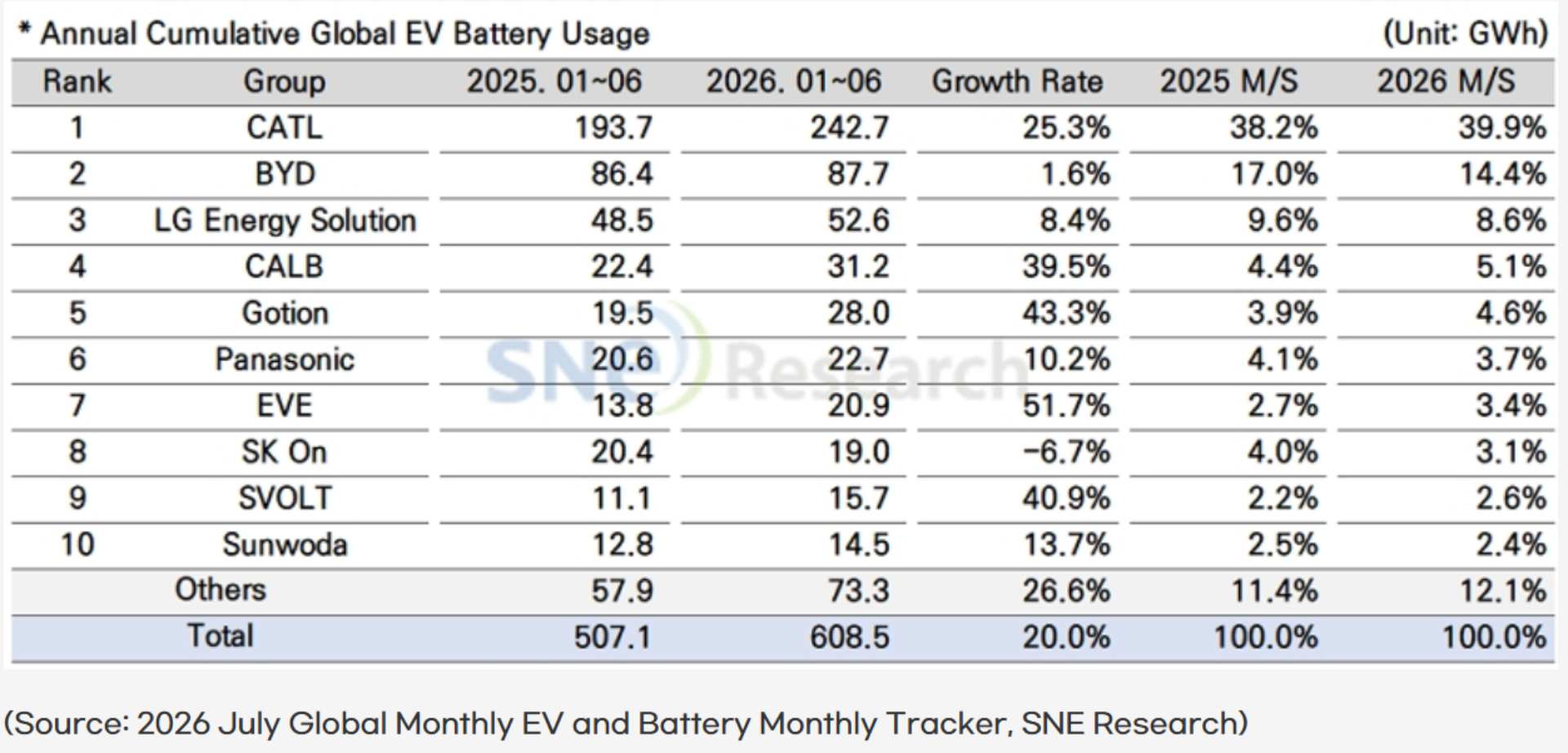
BYD maintained second position with 87.7 GWh, although its growth was much slower, at 1.6%. Its market share fell from 17% to 14.4%. Together, CATL and BYD therefore control 54.3% of the global EV battery market.
South Korea’s LG Energy Solution remains third, with 52.6 GWh and an 8.6% share, followed by two rapidly expanding Chinese manufacturers: CALB, which grew 39.5% to 31.2 GWh, and Gotion, up 43.3% to 28 GWh. Panasonic ranks sixth with 22.7 GWh.
Growth among some of the other Chinese players was even stronger. EVE increased battery deployment by 51.7%, while SVOLT recorded growth of 40.9%. By contrast, South Korea’s SK On declined 6.7% to 19 GWh.
Chinese battery makers are expanding beyond their domestic market
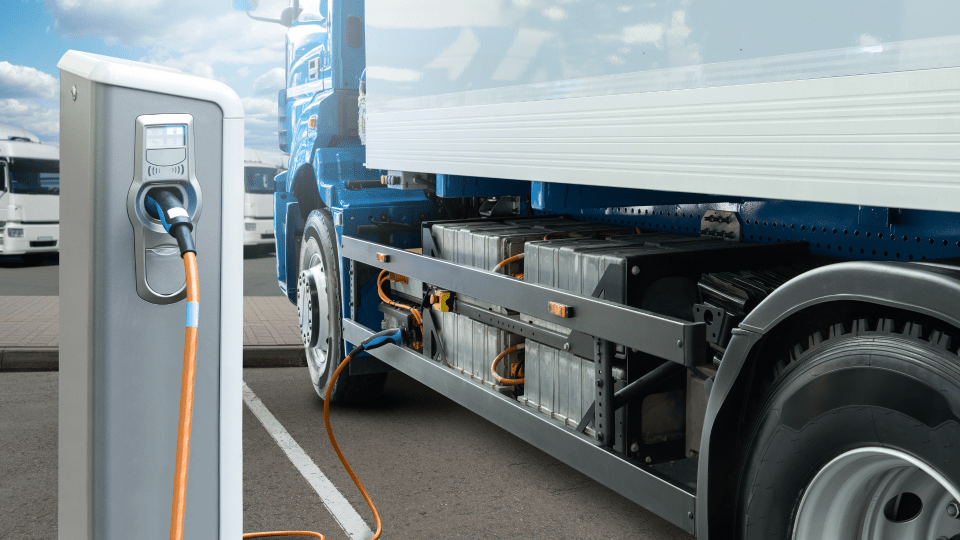
According to SNE Research, the expansion of Chinese manufacturers is being supported by the scale of their domestic market and the cost competitiveness of LFP battery technology. Increasingly, however, these companies are also extending their supply relationships to international vehicle manufacturers and, importantly, to the commercial vehicle sector.
This makes the trend particularly relevant for the truck and van industry. Battery competition is no longer determined solely by manufacturing capacity: localization requirements, regional production footprints and supply-chain traceability are becoming increasingly important, particularly in Europe.
SNE Research points in this respect to the upcoming implementation of the EU Battery Passport, alongside growing requirements for supply-chain data management. Future competitiveness, the analysts conclude, will therefore depend on a combination of production efficiency, customer diversification, battery chemistry — including LFP and next-generation cylindrical cells — and the ability to comply with increasingly stringent regional supply-chain requirements.